Surf City Drafts Local E-Bike and Multi-Use Path Rules Ahead of December 1
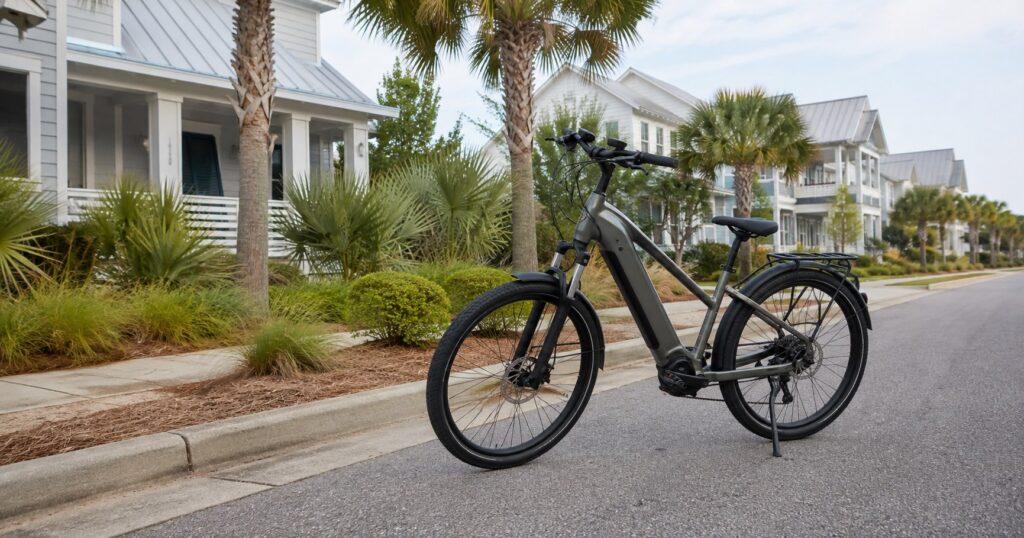
An electric bicycle parked along a residential street in a coastal North Carolina neighborhood, with palm trees and raised beach houses in the background.

What changes December 1 for young riders, parents and drivers, what Surf City’s code allows on its sidewalks and bridge path today, and what town staff have drafted. We read the state session law, the town code as currently published, and the redlined Chapter 17 in the Town Council’s August 20 work session packet.
Surf City E-Bike Rules and the New State Law
- Young riders: state law requires no driver license, registration or insurance for an e-bike. A pedal-assist bike that reaches 28 mph is a moped today, with a minimum age of 16, and becomes a Class 3 e-bike on December 1.
- Helmets: required for riders and passengers under 18 on a Class 3 e-bike from December 1. Towns may extend the rule to Class 1 and Class 2.
- Surf City today: motor powered bicycles, which the town code defines to include electric, are barred from town sidewalks and the bridge multi-use path. A violation brings a warning citation, then a $50 civil penalty.
- August staff draft: a 20 mph cap on multi-use paths, 10 mph in a bridge safety zone, helmets for operators under 16, and repeal of the sidewalk and bridge path ban.
- Status: no adoption vote has been held, and none is scheduled as of September 29, 2026.
On December 1, a pedal-assist e-bike that reaches 28 mph stops being a moped under North Carolina law. Today that bike requires a rider who is at least 16, DMV registration and liability insurance, and after December 1 it requires none of the three, only a helmet for riders under 18.
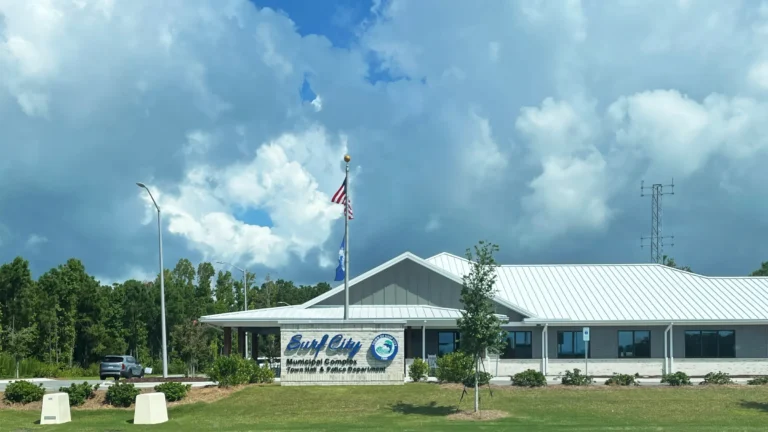
Surf City is writing its own rules for e-bikes on its sidewalks and multi-use path before that date. The town held a public forum on them Monday, September 28, at the Surf City Municipal Complex, located at 214 W. Florence Way in Hampstead, according to the town’s event listing.
Town leaders told WECT their goal is to have local rules written, voted on and adopted by the end of the year.
What Changes for Young Riders on December 1
House Bill 1094, a Department of Transportation omnibus bill, became Session Law 2026-46. Its Section 19 sorts e-bikes into three classes, all limited to a motor of 750 watts or less with working pedals.
| Class | How the Motor Assists | Assist Stops At |
|---|---|---|
| Class 1 | Only while the rider is pedaling | 20 mph |
| Class 2 | Can propel the bike without pedaling | 20 mph |
| Class 3 | Only while the rider is pedaling | 28 mph |
Under current law, a bike with 28 mph of motor assistance is a moped, the UNC School of Government notes. The operator must be at least 16, the bike must be registered with the DMV and insured, and every operator and passenger must wear a helmet.
Session Law 2026-46 moves that same bike into the e-bike definition. E-bikes need no DMV registration, special license or liability insurance, according to a separate School of Government analysis, and state law sets no minimum age to ride one, as our August explainer on NC e-bike and golf cart laws details.
The helmet rule that replaces the moped rule is narrower. From December 1, riders and passengers under 18 on a Class 3 e-bike must wear a helmet that meets federal safety standards. The state’s older Child Bicycle Safety Act requires helmets for bicycle riders and passengers under 16 on public roads, bike paths and rights-of-way, with a fine of up to $10, but its definition of a bicycle is human-powered and does not name e-bikes.
A machine over 750 watts, or one whose motor pushes it past the class limits, is still a moped or a motorcycle under state law, with the age, registration and insurance rules that come with it.
The new law permits e-bikes on all roadways, bicycle lanes and multiuse paths, except where local governments regulate them. New G.S. 160A-300.2 lets a city regulate e-bikes on any multiuse path or sidewalk within its limits, restrict a class or classes, set speed limits, and require helmets for riders and passengers under 18 on Class 1 and Class 2.
Sidewalks and the Bridge Path in Surf City Today
Our review of the town code as published on September 29, 2026, current through an ordinance passed September 1, found three sections that cover e-bikes. Sec. 17-131 defines a motor powered bicycle as one that “may be in the form of electric or gasoline.”
Sec. 17-146 reads, in full: “No motor powered bicycle shall be operated on any town sidewalk or upon the bridge multi use path.” Sec. 17-162 prohibits motorized vehicles on all town bikeways, with exemptions for emergency vehicles and maintenance vehicles the town manager authorizes.
The bicycle article carries no penalty of its own, so the town’s general penalty section, Sec. 1-6, applies. A violation is a civil matter, not a crime: the town issues a warning citation first, and a second citation carries a $50 civil penalty, due within 15 days.
Sec. 17-145 bars a parent or guardian from authorizing or knowingly permitting a child under 18 to violate the bicycle article, which includes the sidewalk and bridge path ban. The article sets no numeric speed limit and no helmet requirement.
What the Town Is Proposing
Town Manager Kyle Breuer presented a redlined Chapter 17 at the council’s August 20, 2026 work session. The staff draft adds the three state classes to the town’s definitions and lists e-bikes among the devices allowed on town multi-use paths.
It caps every device on the path at 20 mph and bans any electric or motorized device traveling faster. It sets a 10 mph Surf City Bridge Safety Zone between the roundabouts at either end of the bridge, requires helmets for operators under 16 on bicycles and e-bikes, and strikes Sec. 17-146 entirely.
| Current Code | August Staff Draft | State Law | |
|---|---|---|---|
| Helmets | No requirement in the bicycle article | Operators under 16 on a bicycle or e-bike | Riders and passengers under 18 on Class 3; the under-16 bicycle helmet law does not name e-bikes |
| Speed on Multi-Use Paths | Reasonable and prudent, no number | 20 mph, and 10 mph in the bridge safety zone | No path limit set; towns may set one |
| E-Bikes on Sidewalks | Barred, along with the bridge multi-use path | Sec. 17-146 struck; a replacement sidewalk rule is not stated in the materials we reviewed | Towns may restrict a class or classes |
| Penalties | Warning citation, then a $50 civil penalty | Civil penalties per the town’s adopted fee schedule; a device may be impounded after more than three | Not stated in the materials we reviewed. |
The draft does not match what town leaders described after the forum. WECT reported they are considering helmets for all minors and keeping certain bikes off sidewalks, while the August draft sets the helmet age at 16 and removes the sidewalk ban. We read that as a proposal still changing after the forum, not a settled text.
The August 20 minutes, included for approval in the September 1 agenda packet, record no vote on Chapter 17. The town calendar lists a council meeting on October 6 and a work session on October 15, and neither agenda was posted as of September 29. Surf City Town Hall is at 910-328-4131.
When There Is a Crash
On the road, an e-bike is a vehicle. The School of Government’s analysis notes that bicycles and e-bikes are subject to the state traffic rules that apply to drivers, except those that by their nature cannot apply.
State law requires no liability insurance on an e-bike. Our August explainer found that standard homeowners policies commonly exclude liability for an owned self-propelled vehicle used away from the home, and after December 1 a 28 mph bike no longer carries the moped insurance requirement.
When an e-bike and a car collide, North Carolina’s contributory negligence rule and the rider’s age shape the case. A plaintiff even slightly at fault normally recovers nothing, but a child under 7 is conclusively presumed incapable of negligence, and a child 7 to 13 is presumed incapable unless the driver proves otherwise, as our August explainer details with the case law behind each rule.
Surf City’s August draft speaks to the path itself. It states that everyone who uses the multi-use path does so at their own risk and that the town assumes no liability for accidents, injuries or death there. Anyone who damages path property pays for the repair on top of any civil penalty, and the draft carries the parent clause into the path article.
The Enforcement Problem
At the forum, residents pointed out that an officer cannot easily tell what class of bike is passing, according to WECT, and leaders said any new rules have to be realistic. The August draft ties its path rules to speed rather than class, and the August 20 minutes record more discussion about writing rules that are enforceable.
Sources
- Town of Surf City – Multi Use Path and E-Bike Regulation and Ordinance Review: the September 28, 2026 forum date, time and address.
- WECT – Surf City considers stricter e-bike rules ahead of new state law: what leaders are considering after the forum, the year-end adoption goal and the enforcement comment.
- NC General Assembly – House Bill 1094: bill history and the July 7, 2026 signing.
- NC General Assembly – Session Law 2026-46: Section 19, the e-bike classes, the Class 3 helmet rule, G.S. 160A-300.2 and the December 1 effective date.
- UNC School of Government – New Statewide Legislation Regarding E-Bikes: a 28 mph bike is a moped under current law, and the moped age, registration, insurance and helmet rules.
- UNC School of Government – The Current State of Electric Bicycles and the Law: no registration, license or insurance for e-bikes, and their status as vehicles.
- NC General Statutes – G.S. 20-171.9: the under-16 bicycle helmet requirement and its $10 fine.
- NC General Statutes – G.S. 20-171.8: the Child Bicycle Safety Act definition of a bicycle.
- Surf City Code of Ordinances – Sec. 1-6: the warning citation and $50 civil penalty.
- Surf City Code of Ordinances – Sec. 17-131: the current definition of a motor powered bicycle.
- Surf City Code of Ordinances – Sec. 17-146: the current sidewalk and bridge path ban.
- Surf City Code of Ordinances – Sec. 17-162: the current ban on motorized vehicles on bikeways.
- Town of Surf City – August 20, 2026 Work Session Agenda Packet: the redlined Chapter 17 staff draft, including the path liability and parent clauses.
- Town of Surf City – September 1, 2026 Regular Meeting Agenda Packet: the August 20 work session minutes.
Advertisement
Support local coverage: Topsail Guide is independently operated and supported by readers. If our stories and guides are useful, you can support the site here.
See something wrong? Report a correction or read our editorial standards.