E-Bikes in Topsail-Area Neighborhoods: What Parents and Residents Need to Know
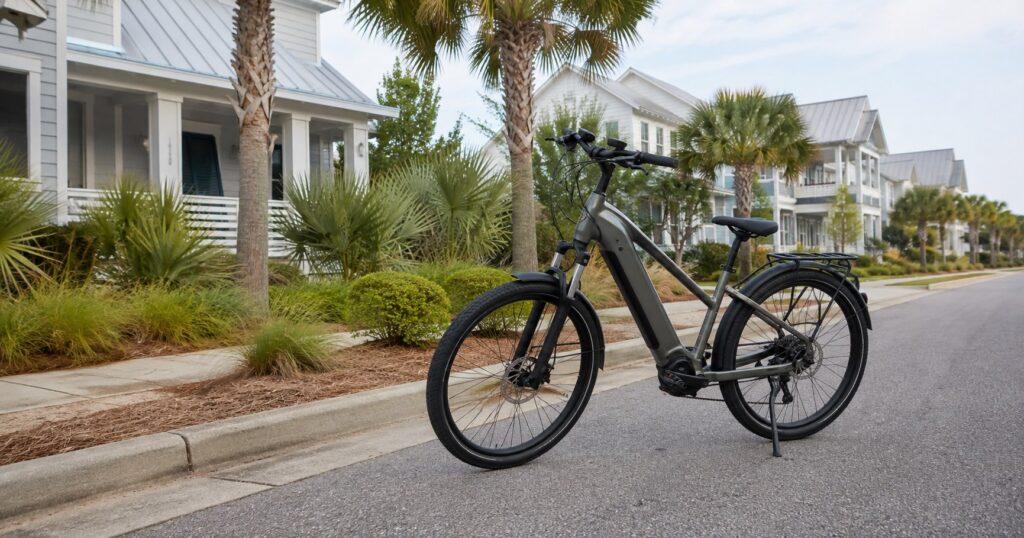
An electric bicycle parked along a residential street in a coastal North Carolina neighborhood, with palm trees and raised beach houses in the background.
E-bikes and golf carts have taken over neighborhoods from Hampstead to Sneads Ferry, and most of what gets argued about online is wrong in both directions. Here is what North Carolina law actually says about age limits, helmets, insurance and private roads, what your HOA can really enforce, and what changes on December 1.

A guide, not legal advice. Every legal statement here is sourced to the North Carolina General Statutes, session law, published appellate opinions, or the current codified ordinance of the named town or county. Ordinance research was current as of August 4, 2026, and the state e-bike law changes on December 1, 2026. Codes change. If a decision matters, verify the current text and talk to an attorney.
We are not taking a side. The goal is that a parent, a rider, an HOA board member and a frustrated neighbor can each read this and learn what their actual rights are, including where the law does not support what they assumed.
If you live anywhere between Hampstead and Sneads Ferry, you have probably had some version of the same afternoon. A group of them comes around the corner four or five wide, and instead of tightening up to let you through they hold the line and make you crawl behind them. Somebody is up on one wheel. Somebody else is riding no-handed with a phone out. When you finally find room to ease past, one of them drifts toward your lane rather than away from it. There is a hand gesture, and something said through the window that you catch about half of. Then they roll the stop sign at the pool without slowing and cut across the corner lot where the sod went in three weeks ago.
What lands hardest is not the speed. It is the confidence. The whole performance runs on a shared understanding that nothing is going to come of it, that you are a person in a car with nowhere to go with your complaint, and that they will be back tomorrow.
That understanding is not entirely wrong, which is what makes it so aggravating. It is not entirely right either. In parts of Pender County residents say they have called the Sheriff’s Office and deputies have come through, sometimes to break up a group at a mailbox cluster, and in at least some cases to stand there while a parent walks a bike home. The same thing is happening with golf carts, which belong in this conversation because in most of these neighborhoods the carts and the bikes are the same story with different tires.
Then somebody posts about it, and the thread goes where these threads always go. Call the sheriff. They’re just kids. It’s the parents. These things are illegal under 16. You can’t do anything, it’s a private road. Almost every confident claim in that thread is wrong, on both sides. Here is what is actually true.
- The state law changes December 1, 2026. Session Law 2026-46 creates Class 1, 2 and 3 e-bikes and, for the first time, lets towns and counties set their own rules on paths and sidewalks.
- Most of the machines people are angry about are not e-bikes. Over 750 watts, over the speed cap, or no working pedals, and it is legally a moped or a motorcycle. That means a minimum age of 16, registration and insurance.
- On a private neighborhood road, most traffic laws do not apply. Stop signs, right of way and wrong-side-of-the-road all require a “highway.” Two rules do survive on any street, and they are the two that matter most.
- Nobody has to ride single file. North Carolina has no such law. It is the most repeated false claim in these arguments.
- Golf carts have a hard minimum age of 16 on any public street. The legislature wrote the number into the statute. A town cannot lower it and an HOA cannot waive it.
- If you hit one of them, their age decides your case. A child under 7 legally cannot be at fault in North Carolina, no matter what they did.
What These Machines Actually Are
North Carolina law does not care what the sticker says, what the shop called it, or what the kid calls it. It cares about three things: does it have working pedals, is the motor 750 watts or less, and how fast will the motor alone push it on flat ground. Twenty miles an hour is the line today; after December 1, up to 28 if it is pedal-assist.
Yes to all three and you have an electric assisted bicycle under G.S. 20-4.01(7a), treated as a bicycle: no license, no registration, no insurance, no minimum age. Fail even one and it lands somewhere else entirely.
| What it does | What it legally is | What that triggers |
|---|---|---|
| 750W or less, at or under the speed cap, working pedals | Electric assisted bicycle | Treated as a bicycle. Helmet required under 16 on public roads and paths. |
| Exceeds the caps, tops out at 30 mph or less | Moped, G.S. 20-4.01(27)j | Minimum age 16. DMV registration. Liability insurance. Helmet at any age. |
| Over 30 mph | Motorcycle, G.S. 20-4.01(27)h | Registration, title, insurance, and a license with a motorcycle endorsement. |
Now go look at what is in the garages. A Sur-Ron Light Bee X weighs about 125 pounds and will do roughly 47 miles an hour. A Talaria Sting is right with it at about 128 pounds. Under North Carolina law these are motorcycles, and the 13 year old on one cannot legally operate it on any road in this state.
That is the sentence worth remembering. When a kid goes past your mailbox at 40, you are not watching a bicycle break a neighborhood rule. You are watching an unregistered, uninsured motorcycle ridden by someone who cannot legally hold a license for it. And it usually cannot be fixed with paperwork: G.S. 20-53.4 requires a manufacturer’s certificate of origin and a vehicle built for highway use, so a converted machine often cannot be registered at all.
Most E-Bikes Are Not the Problem, and Rules That Pretend Otherwise Fail
The overwhelming majority of e-bikes sold in this country are pedal-assist commuters that top out at bicycle speeds, ridden by adults going to the pier and teenagers going to a friend’s house.
Why it matters for your board
- Rules that sweep those in alongside a Sur-Ron produce an ordinance that annoys the retiree and does nothing about the machine that caused the complaint.
- New Hanover County Commissioner LeAnn Pierce made this exact point in an April 2025 discussion, cautioning against conflating e-bikes with motorized bikes.
- Get specific about the machine and you will get further than getting loud about the kids.
What Changes on December 1
House Bill 1094 was signed on July 7, 2026 and became Session Law 2026-46. Section 19 rewrites the state e-bike law effective December 1, 2026. It creates the three-class system: Class 1 is pedal-assist to 20 mph, Class 2 is throttle to 20 mph, Class 3 is pedal-assist to 28 mph. The 750 watt cap and the working-pedals requirement do not change, so everything above about mopeds and motorcycles stays exactly as it is. It also requires helmets for riders under 18 on a Class 3.
And here is the part every town board and HOA in this area should have circled: new G.S. 160A-300.2 and 153A-245.1 give cities and counties explicit authority to regulate e-bikes on multiuse paths and sidewalks, restrict specific classes, set speed limits, and extend the helmet rule to Class 1 and 2 riders under 18. Right now our towns do not have that authority. On December 1 they will.
As of this writing we could not find a single public discussion of e-bike rules at Surf City, Topsail Beach, North Topsail Beach, Holly Ridge or either county board. Leland took up an ordinance in June, Carolina Beach has been asking for this authority since May, and a 24 year old e-bike rider was killed at Monkey Junction in Wilmington in April. If you want your board to act, the window to get on an agenda is now.
And Then There Are the Golf Carts
With carts the law is not ambiguous at all. It is just widely unknown.
A golf cart, at G.S. 20-4.01(12b), is “not capable of exceeding speeds of 20 miles per hour.” A low-speed vehicle, at G.S. 20-4.01(27)g, has four wheels and a top speed of more than 20 but less than 25. The categories are mutually exclusive, decided entirely by top speed, and the distinction drives everything: an LSV can be registered and a golf cart generally cannot. That is why a standard cart cannot lawfully be driven on a public street at all unless the local government has passed an ordinance allowing it.
Golf Carts: The Age Is Not Your Town’s to Give Away
Both G.S. 160A-300.6 and G.S. 153A-245 contain the same line: “No person less than 16 years of age may operate a golf cart on a public street, road, or highway.”
What that means
- It is a floor written into state law. A town’s discretion runs upward only.
- No town in North Carolina can set it lower, and no HOA can grant an exception.
- If a community has been letting 14 year olds run carts to the pool because “the town allows carts,” the town allowing carts is not the question.
- For an LSV on a public street it is stricter still: registration under G.S. 20-121.1 pulls in G.S. 20-7, so the operator needs an actual driver license.
On a private neighborhood road
- There is no license charge available, because that requirement is tied to highways. That is where people stop reading, and where they get it wrong.
- A golf cart is a motor vehicle under G.S. 20-4.01(23), which carves out mopeds and e-bikes but not carts.
- So reckless driving (G.S. 20-140) and impaired driving (G.S. 20-138.1) both apply on your street, exactly as they would to a pickup truck.
- G.S. 20-32 reaches the adult who handed over the keys. In Southern Shores in June 2026 a minor was driving a rented LSV with five kids aboard when one was ejected, and the parent was cited under it.
Locally: Surf City has no golf cart ordinance and says carts are not permitted on town streets unless street legal. Topsail Beach defaults to state law. North Topsail Beach repealed its ordinance effective July 5, 2023 and now runs on state LSV rules, though a stale page on the town’s own site still describes the old permit system. Holly Ridge runs a permit and sticker program under Chapter 19. We found no cart ordinance in either county code.
Carts are also not gentle. NEISS data in the Journal of Safety Research counted 156,040 emergency department visits from 2007 through 2017, roughly 14,200 a year, and an earlier analysis found 31.2 percent were children under 16. The mechanism is almost never a collision. It is a kid falling or being ejected on a turn, from a vehicle with no doors, no belts and a high center of gravity.
What the Law Says About How They Ride
Bicycles and e-bikes are vehicles under G.S. 20-4.01(49), so riders owe the same duties as drivers. But that same statute applies those duties “upon a highway,” and highway has a specific legal meaning: a road open to the public as a matter of right. Most rules of the road are locked to that word. Stop signs require an “intersection,” which is legally the joining of two highways. On a genuinely private, gated street, running a stop sign is not a chargeable stop sign violation, the same way it is not in a grocery store parking lot.
Before you get discouraged, find out what kind of road you live on. A great many North Carolina subdivision streets were accepted into the state secondary road system and are maintained by NCDOT. If yours is state-maintained it is a public highway and every rule below applies in full. Most residents have never checked, and it changes what you can ask for.
| The behavior | The statute | Private road? | Penalty |
|---|---|---|---|
| Reckless riding, wheelies, swerving at cars | G.S. 20-140(b) | Yes | Class 2 misdemeanor |
| Riding at night with no lights | G.S. 20-129(e) | Yes | Infraction, up to $100 |
| Cutting in with no signal | G.S. 20-154(a) | Yes | Infraction, up to $100 |
| Tearing up lawns and common areas | G.S. 14-127 | Yes | Class 1 misdemeanor |
| Running stop signs | G.S. 20-158 | No, highway only | Infraction, up to $100 |
| Failing to yield right of way | G.S. 20-155 | No, highway only | Infraction, up to $100 |
| Riding on the wrong side | G.S. 20-146(a) | No, highway only | Infraction, up to $100 |
| Riding four across | No such law | Not illegal in NC | None |
Two rules survive anywhere, and they happen to be the two that matter. Reckless driving, G.S. 20-140(b), says “vehicle” rather than “motor vehicle” and expressly reaches any public vehicular area, which under G.S. 20-4.01(32)(c) includes “a road used by vehicular traffic within or leading to a gated or non-gated subdivision.” It requires no proof that anybody meant anything, just absence of due caution in a manner likely to endanger. Wheelies through an intersection, swerving at a car, donuts on a cul-de-sac all fit. It is a Class 2 misdemeanor, not an infraction.
The lighting rule, G.S. 20-129(e), is the one nobody uses. Every bicycle ridden at night on any public street, public vehicular area or greenway needs a front lamp visible from 300 feet and either a rear lamp or clothing bright enough to be seen from 300 feet. A pack riding your neighborhood at dusk with no lights is in violation today, on your private street, with no ordinance required.
There Is No Single-File Law in North Carolina
Not for bicycles, not for e-bikes, not for kids, not for adults. Riding four across a neighborhood street is obnoxious. It is not illegal.
Who says so
- NCDOT’s own guide to bicycle law states there is no law requiring single file, and none granting a right to ride two abreast either.
- The UNC School of Government says the same.
- A legislative working group considered creating one in 2020 and specifically recommended against it.
- If you lead with this complaint you hand the other side an easy win. What you can raise instead is G.S. 20-146(b), which requires slower vehicles to keep right on a public road and does bind cyclists.
Why Nothing Seems to Happen
North Carolina juvenile jurisdiction splits three ways, and traffic offenses sit oddly. Under 10, there is no delinquency jurisdiction for traffic offenses at all. Ages 10 to 15 go to juvenile court, where most first referrals are diverted rather than adjudicated, which from the outside looks exactly like nothing happening. Ages 16 and 17 go to adult district court, because Chapter 20 violations were deliberately carved out of Raise the Age.
The kids generating the most complaints are usually in that 10 to 15 band, which is precisely where you will see the least visible consequence. That is not the deputy blowing you off. That is the statute. Which is why departments across the state have pivoted to two other tools: impounding the machine, and charging the parents. G.S. 14-316.1, contributing to the delinquency of a minor, is a Class 1 misdemeanor, and it does not require the child to be adjudicated anything. In April 2026 Cary officers charged two parents under it after their 15 year old was cited for reckless riding.
Why They Ride Worse in a Group
The pack riding is real, and it is one of the most replicated findings in developmental psychology. In 2005 Laurence Steinberg and Margo Gardner ran 306 people through a driving simulation, alone and then with two peers watching. Alone, all three age groups performed equally safely. That control is the most important result in the study.
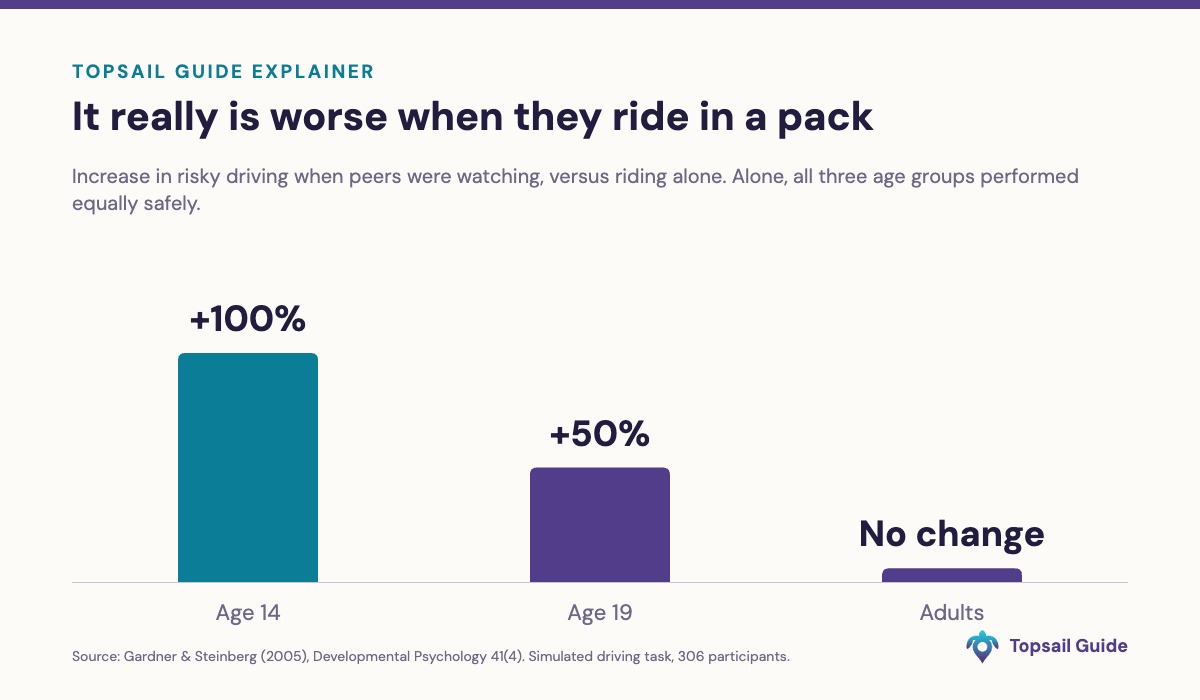
The 2011 follow-up found the mechanism. In adolescents, peer presence lit up the brain’s reward circuitry while the cognitive control system, the part that does the braking, showed no change at all. So it is not that kids have no brakes. They brake fine alone. Puberty puts a large, socially triggered boost on the accelerator while the brakes are still on a slow build into the mid-20s.
And the peers in that study were in a different room, watching on a monitor, not allowed to interact. Nobody dared anybody. Later work found the effect holds even when the observer is anonymous. Mere presence is enough.
Which means two things people always say are both true and both beside the point. “My kid would never do that on his own” is probably accurate. “His friends aren’t bad kids” probably is too. Neither predicts what happens when six of them are together, because the variable is not the kid and it is not the friends. It is the group. That is a targeting instruction, not an excuse: rules that apply to all riders rather than singling out kids, adult presence when and where packs form, and helmet expectations set as a neighborhood norm. Adolescent helmet use tracks what riders believe their friends do, not access or education, which is a problem a neighborhood can solve and a parent alone mostly cannot.
If You Hit One of Them, Their Age Decides Your Case
North Carolina uses contributory negligence, which is unusually harsh: a plaintiff even one percent at fault normally recovers nothing. But that rule collides with a second rule about children, and the collision is where drivers get hurt.
Same Collision, Opposite Outcomes, and the Only Variable Is a Birthday
A child rides out from between two parked cars. You are doing 25. Most people assume that because the child was careless, you are covered. In North Carolina that can be exactly backwards.
Under 7 years old
- Conclusively presumed incapable of contributory negligence (Walston v. Greene, 1958).
- Not “hard to prove.” Conclusive. You have no comparative fault defense at all, regardless of what the child did.
Ages 7 to 13
- Rebuttable presumption that the child cannot be negligent, and the burden is on you to prove otherwise.
- Even then the child is measured against a reasonably careful child of that age and experience, not against an adult.
- The average age in a pediatric e-bike crash is 12.6, squarely inside this window.
14 and older
- The presumption flips and generally favors the driver.
- Contributory negligence can bar the claim entirely.
In fairness to drivers, this does not mean automatic liability. In Colson v. Shaw (1980) the Court of Appeals held that no presumption of negligence arises from the mere fact that a motorist strikes a child who darts into the street. The accurate statement is narrower and more useful: the child’s carelessness will not rescue you, but your own driving still has to be reasonable, and reasonableness gets judged in light of the foreseeable presence of children. Twenty-five through a neighborhood where you can see kids is a completely different case from forty.
Two practical notes. Misdemeanor death by vehicle, G.S. 20-141.4(a2), requires no recklessness and no impairment: any moving violation that proximately causes a death is enough, and it is a Class A1 misdemeanor. And North Carolina’s minimum liability limits rose on July 1, 2025 to $50,000 per person, which pediatric trauma routinely runs past. Anything above your limit comes out of you personally. Raising liability limits is one of the cheapest coverage changes you can make. Your uninsured motorist coverage does not help here, because that protects you when someone else injures you.
What Your HOA Can Actually Do
Under G.S. 47F-3-102 an association may adopt rules and regulate the use of common elements, and private streets are usually common elements. It may impose reasonable fines or suspend privileges “after notice and an opportunity to be heard.” G.S. 47F-3-107.1 sets the ceiling: a hearing before the board or a panel of members who are not officers, a 15 day appeal window, and a fine of up to $100 for the violation plus up to $100 per day for a continuing violation starting five days after the decision.
The Mistakes That Turn an Enforcement Effort Into a Lawsuit
Most of what gets proposed at these meetings falls apart on contact with the statute.
Your declaration may not let you fine at all
- In Wise v. Harrington Grove (2003) the North Carolina Supreme Court held the Planned Community Act does not automatically grant fining power.
- If your community predates 1999 and the declaration is silent, amend it before you issue a single fine.
Age-based rules are a fair housing problem
- “No one under 16 on the common areas” is a rule aimed at children, and familial status is protected under the federal Fair Housing Act.
- Write it around the machine instead: wattage, speed, working pedals, helmets for everyone, no riding on turf. Those bind the 45 year old on a Super73 exactly as they bind the 14 year old.
A rule you do not enforce is worse than no rule
- Selective enforcement hands every homeowner a waiver defense.
- An association that owns its streets owes lawful visitors reasonable care under Nelson v. Freeland (1998); adopting a safety rule and then ignoring it can create liability rather than reduce it.
What actually works, in order: find out whether your streets are state-maintained or private, because that single fact decides which half of the traffic code applies. Write rules around wattage, speed and pedals using the state definitions so they still work on December 1. Document everything, with dates, times and photos from a distance. Post your common areas and issue written trespass notices to repeat offenders, because G.S. 14-159.13 requires prior notice, and that converts the next incident from a complaint into a chargeable offense. Do not confront riders directly. And refer the machines that are legally mopeds or motorcycles to the Sheriff, because that is state law and does not depend on your covenants at all.
Town by Town: What Is on the Books Right Now
| Jurisdiction | E-bike rule? | The specifics |
|---|---|---|
| Surf City | Yes, the only one | § 17-146 bans “motor powered bicycles,” defined to include electric, from sidewalks and the bridge multiuse path. § 17-162 bans motorized vehicles on all bikeways. |
| Topsail Beach | Partial, with a gap | Path rules are built around “bicycles” (human-powered only) and “motor vehicles” (which state law says excludes e-bikes), so they miss e-bikes entirely. The beach strand rule does reach them. |
| North Topsail Beach | Nothing | No e-bike provision in the code. The bike path rule appears only on the town website. Golf cart ordinance repealed July 2023. |
| Holly Ridge | Nothing | Bicycles banned on business district sidewalks. Parks rules bar dirt bikes, ATVs and “like motorized vehicles.” E-bikes are never named. |
| Hampstead | No town exists | Unincorporated Pender County. No council, no town police, no municipal code. Pender County Sheriff and NCDOT. |
| Sneads Ferry | No town exists | Unincorporated Onslow County. Onslow County Sheriff and NCDOT. |
| Pender County | Policy only | No traffic chapter in the county code at all. Parks and Recreation banned e-bikes from county parks in November 2025, including the Sloop Point Loop Road Multi-Use Path and Penderland Greenway, but § 28-46 makes departmental rules non-citable. |
| Onslow County | Nothing | The motor vehicle chapter covers only abandoned vehicles. The parks chapter never mentions bicycles. |
Wording decides everything. Surf City banned “motor powered bicycles” and defined the term to include electric. Topsail Beach banned “motor vehicles,” a category state law expressly says does not include e-bikes. Two ordinances passed two years apart that look alike, one of which works. And the one e-bike restriction covering Hampstead has the weakest enforcement mechanism available.
What the Numbers Show, and What They Do Not
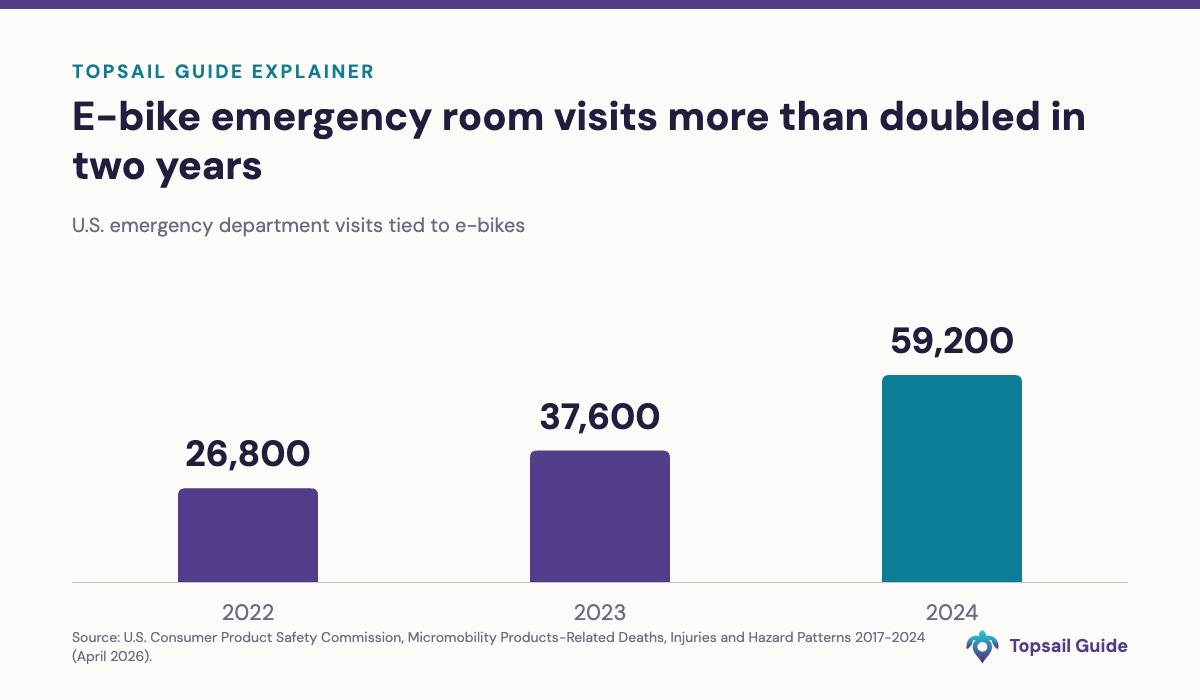
E-bike emergency department visits nationally went from 26,800 in 2022 to 37,600 in 2023 to 59,200 in 2024. Deaths went from zero in 2017 to 97 in 2024, and e-bikes are now the majority of all micromobility deaths the Consumer Product Safety Commission tracks. Only 44 percent of injured e-bike riders were wearing a helmet, and helmet use is falling about 6 percent a year. In North Carolina, bicyclist deaths went from 20 in 2022 to 40 in 2023, in a year when total state traffic deaths fell 5.5 percent.
The Trend Is Real. The Precision Is Not.
Four things belong in any honest version of this, and you will get hit with them if you cite the numbers at a meeting.
What the data cannot do
- Injury databases do not cleanly separate e-bikes from electric dirt bikes. That is a genuine weakness, and it also proves the point of this article: if the federal injury surveillance system cannot tell these machines apart, no wonder local ordinances keep missing.
- There is no reliable miles-ridden denominator, so counts rise partly because ridership rises. A 2026 Norwegian study using exposure data found e-bikes had lower injury risk per kilometer than regular bicycles.
- Federal crash reporting changed its counting rules in 2022, folding motorized bicycles into the bicycle category, so some of the recent rise is reclassification.
- A Minnesota study of 514 e-bike injuries found adults were 81 percent of them and riders 15 to 17 were 7 percent, with 98 percent treated and released. That is not a teenage crime wave. It is kids falling off fast machines.
One more thing worth saying plainly. We searched local news, sheriff’s releases and town agendas across all six communities for 2024 through 2026 and found no reported e-bike crash, no enforcement campaign and no board discussion. That is not the same as nothing happening, since neighborhood incidents rarely reach a newsroom. But this corridor has no public record of a problem everyone here is talking about, at the exact moment its towns are about to get new authority. If you have documentation of an incident, we want to hear about it.
What to Do, Depending on Who You Are
If You Are a Parent
First, the part in your favor: on a legal electric assisted bicycle your child is not breaking any state law by riding, at any age. Most of what circulates online about e-bike age limits is false, and you are entitled to say so. Now the rest. If you own a golf cart, your child cannot drive it on a public street until 16, and no town or HOA can waive that. Look up the wattage and top speed of whatever your kid rides, from the spec sheet rather than the marketing page, then call your insurance agent with those two numbers and ask specifically whether liability is covered when the machine is ridden off your property. Standard homeowners policies treat a self-propelled vehicle as a motor vehicle and commonly exclude an owned one used away from your insured location, which is exactly your neighborhood street. And know that under Moore v. Crumpton a parent can be liable for failing to control a child where the parent knew or should have known of the need to, which means every written notice you receive is evidence you knew.
If You Are a Rider
E-bikes are prohibited on Surf City sidewalks and the bridge path, and motorized vehicles are prohibited on Surf City bikeways generally. They have been prohibited on Pender County’s Penderland Greenway and the Sloop Point Loop Road Multi-Use Path since November 2025, and are not permitted on the beach strand in Topsail Beach or Surf City. Everywhere else around here, state law is all there is, which mostly means ride like a vehicle, because legally you are one. Lights after dark, on any street. And reckless riding is a misdemeanor on your own neighborhood road.
If You Are on a Board
For an HOA: confirm your declaration actually grants fining authority, write rules around the machine rather than the age, build the hearing process G.S. 47F-3-107.1 requires and then follow it every time. For a town or county board: December 1 gives you authority you do not have today, and if you already have an ordinance, check whether it says “motor vehicle” or “motorized vehicle,” because under state law those two phrases produce opposite results.
Frequently Asked Questions
Can My HOA Ban E-Bikes Outright?
On common areas and private streets, generally yes, if your declaration supports regulating common elements and the rule is reasonable and evenly enforced. A ban reaching onto an owner’s own lot, such as prohibiting garage charging, is much weaker ground.
Can a Deputy Enforce Our Neighborhood Speed Limit Sign?
Not as a speeding charge. Posted HOA limits are not statutory limits. What is available is G.S. 20-141(a), speed “greater than is reasonable and prudent,” and G.S. 20-140(b) reckless driving, both of which do reach neighborhood roads.
Is It Illegal to Ride Four Across?
No. North Carolina has no single-file law. It is the most common false claim in these arguments.
My Kid Is 12. Can He Legally Ride an E-Bike?
On a true electric assisted bicycle, yes. There is no state minimum age, though a helmet is required under 16 on public roads and paths. On anything over 750 watts or over the speed cap, no, because that is a moped or motorcycle and the minimum is 16.
How Old Do You Have to Be to Drive a Golf Cart?
On any public street, road or highway, 16, written directly into G.S. 160A-300.6 and G.S. 153A-245. A town can require more but cannot allow less, and an HOA cannot waive it. For a low-speed vehicle on a public street, the operator needs an actual driver license.
What Happens if a Kid Gets Caught?
It depends on age. Under 10, there is no traffic jurisdiction at all. Ages 10 to 15 go to juvenile court and are usually diverted. Ages 16 and 17 go to adult district court, the same as anyone else.
Are E-Bikes and Golf Carts Covered by Homeowners Insurance?
Often not, for liability, when the vehicle is owned and used away from your property. Standard forms exclude motor vehicle liability. Ask your agent about the ISO HO 24 13 endorsement for e-bikes, and about a specific rider for a cart.
Does Any of This Apply in Hampstead?
There is no Town of Hampstead, so there is no municipal ordinance. State law applies, enforced by the Pender County Sheriff. The one local restriction is the county parks policy covering the Sloop Point Loop Road path and Penderland Greenway.
The Bottom Line
If you came here frustrated, some of this went your way and some did not. Riding four across is legal and you should stop leading with it. But reckless riding is a misdemeanor on your own street, riding without lights after dark is a violation on your own street, and tearing up a lawn is a property crime with a real charge attached.
If you came here as a parent tired of your family being discussed in a neighborhood group, some of it went your way too. Your kid is not breaking the law by riding an e-bike, at any age, on a legal machine. But if that machine is over 750 watts, or there is a cart involved and your child is under 16 on a public street, the exposure is real and it is yours.
The thing both sides tend to miss is that the machines are doing more of the work here than the kids are. A meaningful share of what is out there is not an e-bike at all, and once anybody says that precisely, a different set of tools comes into view. That is a more productive conversation than arguing about whose kid is worse, and it is available right now. December 1 gives our towns tools they have never had. Whether anyone picks them up gets decided in a room any of us can walk into.
Sources
Statutes and session law: Session Law 2026-46 (HB 1094) · G.S. 20-4.01 (definitions) · 20-7 · 20-10.1 · 20-32 · 20-34 · 20-53.4 · 20-121.1 · 20-129(e) · 20-138.1 · 20-140 · 20-140.4 · 20-141 · 20-141.4 · 20-146 · 20-154 · 20-155 · 20-158 · 20-171.9 · 20-176 · 14-127 · 14-159.13 · 14-160 · 14-316.1 · 7B-1501 · 47F-3-102 · 47F-3-107.1 · 153A-245 · 160A-300.6, all at ncleg.gov.
Case law and legal analysis: Wise v. Harrington Grove (N.C. 2003) · Walston v. Greene (N.C. 1958) · Colson v. Shaw (N.C. App. 1980) · Watson v. White (N.C. 1983) · Moore v. Crumpton (N.C. 1982) · Nelson v. Freeland (N.C. 1998) · N.C.P.I. Civil 104.25 · UNC School of Government, The Current State of Electric Bicycles and the Law and Is Your Neighborhood’s 17 MPH Speed Limit Enforceable? · NCDOT bicycle and pedestrian laws.
Data: CPSC micromobility report 2017-2024 · JAMA Surgery (Feb 2024) on helmet use and head trauma · NCDOT 2023 Traffic Crash Facts · Truveta Research on pediatric e-bike visits · Journal of Safety Research (2020) and American Journal of Preventive Medicine (2008) on golf cart injuries · Findings (2026) on relative injury risk · Census QuickFacts, Pender County.
Developmental research: Gardner & Steinberg (2005), Developmental Psychology 41(4) · Chein, Albert, O’Brien, Uckert & Steinberg (2011), Developmental Science 14(2) · Albert, Chein & Steinberg (2013) · Ross et al. (2007), Journal of Safety Research, on helmet norms.
Local ordinances: Surf City Code §§ 4-31, 4-33, 17-131, 17-146, 17-162 · Topsail Beach Code ch. 22 · North Topsail Beach Code § 10-32 and town notices · Holly Ridge Code ch. 3, 10, 19 · Pender County Code ch. 28 · Onslow County Code ch. 10, 12. Verified August 2026.
Advertisement
Support local coverage: Topsail Guide is independently operated and supported by readers. If our stories and guides are useful, you can support the site here.
See something wrong? Report a correction or read our editorial standards.