
Eight Hours and 44 Minutes: Surf City Council Denies Hotel and Marina, Doubles Connection Fees
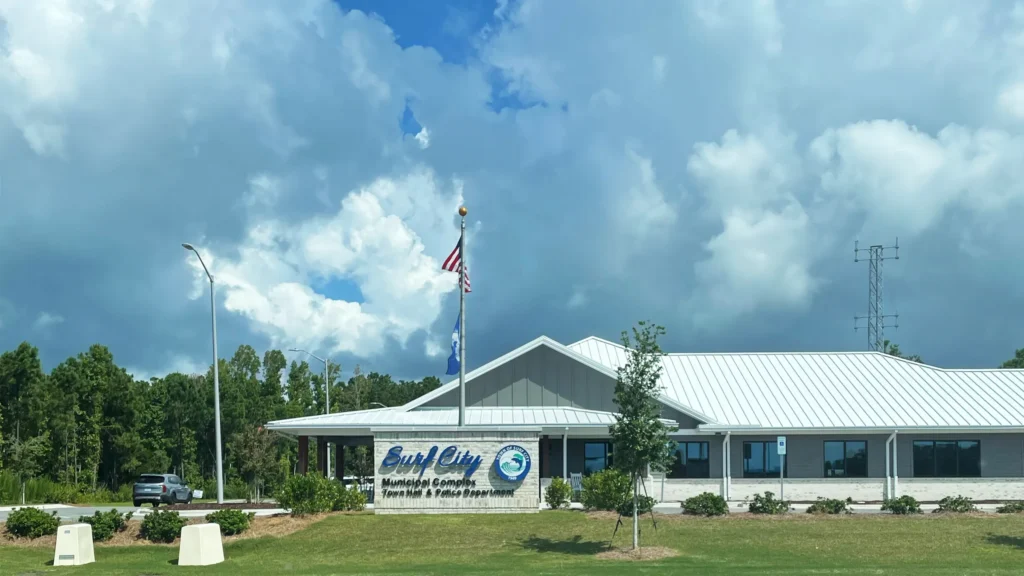
The Surf City Municipal Complex, which houses Town Hall and the Police Department. Surf City, July 2022. Photo: Topsail Guide
In an 8-hour, 44-minute meeting, Surf City denied a 118-room hotel and a 200-unit dry stack marina, then doubled water and sewer connection fees.

SURF CITY, NC (August 5, 2026). The Surf City Town Council gaveled in at 6:00 p.m. Tuesday and did not adjourn until roughly 2:40 Wednesday morning. In that span it denied a 118-room Marriott hotel proposed for the lot beside Town Hall, declined to make the findings required to approve a 200-unit dry stack boat storage facility at the Topsail Island Marina, and adopted a fee schedule that more than doubles the cost of connecting a new home to town water and sewer.
Two of the three headline items went down. The third passed at 2:42 a.m. to an almost empty room. Together they say something the council has not said this plainly before: Surf City does not have the sewer capacity to approve everything in front of it, and it is done pricing that capacity the way it did in 2017.
At a Glance
What the Council Actually Decided on August 4
Three major items, one marathon session, and a clear through-line about wastewater capacity.
The Short Version
- 412 Roland Ave dry stack marina: The council did not find that the applicant met all eight required criteria. A written order comes back for a formal vote on September 1.
- 118-room Springhill Suites at 230 E. Florence Way: Denied. A motion to approve died for lack of a second, then a motion to deny carried with one member opposed.
- System development fees: Adopted as presented, a 106 percent increase across every meter tier. A standard single-family connection goes to $25,180.
- Length: 8 hours 44 minutes, roughly four times a typical Surf City work session.
Editorial Note
How we reported this, and what we are not claiming. We were not in the room. Everything below is drawn from the full meeting video posted by the Town of Surf City, which we reviewed in its entirety, and from the 321-page agenda packet the town published in advance. Official minutes had not been posted to the town’s Agendas and Minutes page as of this writing and will not be approved until a future meeting. Because the recording does not clearly attribute every individual vote, we report how the council voted as a body and do not assign individual votes except where a member is clearly identifiable. This is an early recap published the morning after, written to make eight and a half hours digestible. Details that require the official record will be confirmed by the minutes and by the town’s own communications. Timestamps are included throughout so you can check any of it yourself.
A Meeting Unlike the Town’s Others
The Town of Surf City has live streamed every council meeting since January 2020, an archive now running past 200 videos. Tuesday’s stream ran 8 hours and 44 minutes, roughly four times the length of the town’s recent council work sessions, which typically run two hours or less.
Under the town’s council-manager form of government, regular council meetings are held the first Tuesday of each month at the Surf City Municipal Complex, 214 W. Florence Way. A normal one is over before 9:00 p.m.
This one was not normal, and residents are the reason. The special use permit hearing alone consumed roughly six hours, with sworn testimony, expert witnesses, cross-examination and residents lining up to speak. By the time the council reached the final two items after 2:00 a.m., only a handful of members of the public remained. Residents who stayed through the night posted the results to local community groups before sunrise, and reaction ran strongly in favor of both denials, with many crediting turnout at the meeting for the outcome.
Item 1: Dry Stack Boat Storage at 412 Roland Ave
The item that consumed the night was a special use permit modification for 412 Roland Ave, the 4.74-acre waterfront site known as the Topsail Island Marina, in the C-1 central business district.
Applicant Adam Tucker of ZAC, LLC sought approval for 200 dry stack boat storage units in two buildings, plus marina enhancements. The property is owned by the Gerard T. Hopkins III Trust. The applicant’s team included engineer Jimmy Fentress of Stroud Engineering and attorney Matthew Nichols. Per the staff report from Community Development Director Jeremy B. Smith, the site’s permit history runs back to a 2017 special use permit allowing eight of 15 slips to be used for motorized watercraft rentals, expanded in October 2022 to allow up to 15.
Because a special use permit is a quasi-judicial decision under N.C.G.S. 160D-705, the hearing functioned like a courtroom rather than a policy debate. Witnesses were sworn in. The council had to rule on who had legal standing to cross-examine and call witnesses (26:48). Testimony ran for hours across channel depth and dredging, boat traffic, parking, property values and whether two large buildings would wall the public off from the waterfront. The UNC School of Government’s Coates’ Canons explains why this format binds councils tightly: they may decide only on competent, material and substantial evidence in the record.
Mayor Teresa Batts recused herself from the item, stating on the record that she was doing so “due to a potential financial conflict” (27:03). Under N.C.G.S. 160D-109, a governing board member must not participate in a development regulation decision where the member has a fixed pecuniary interest in the outcome. Mayor Pro Tem Hugh Cannady presided.
Shortly before 2:00 a.m., the council worked through the eight required findings of fact one at a time (7:44:12). It did not find that the applicant met all of them. Traffic congestion was among the criteria the council declined to resolve in the applicant’s favor (7:45:45).
Council members also questioned what the project would do to public access. Arguing against the finding that the use would not impede orderly development of surrounding property, Councilman Andy Pleil pointed to the site’s position in the heart of the central business district and said the proposal would take “an entire section of two some odd acres” and “completely shut out the waterfront from the community” (7:48:12).
Because state law requires every criterion to be met, the town attorney advised that the modification cannot be approved on those findings and asked the council to direct him to draft a written order reflecting its decision. The council did so (7:51:35).
That order comes back for a formal vote at the September 1 meeting. Practically, the project was rejected. Procedurally, the denial is not final until the council adopts the written order, and quasi-judicial decisions carry an appeal path to Superior Court.
Item 2: The 118-Room Springhill Suites, Denied
At 8:02:52, with the clock past 2:00 a.m., the council took up the conditional rezoning that had drawn the most attention going in.
Five Star Capital, LLC asked to rezone 2.92 acres at 230 E. Florence Way, the parcel immediately next to the Surf City Municipal Complex, from R-15 single-family residential to C-3-CZ extended commercial conditional. The plan was a 118-room, four-story Springhill Suites of roughly 70,000 square feet. Port City Daily reported in its July 27 preview that the project carried an estimated cost above $20 million, roughly 40 full-time and part-time positions, and a projected $500,000 a year in municipal and county taxes.
The applicant offered three binding conditions (8:03:33): use limited to a 118-room hotel at four stories, a sidewalk connection along Florence Way, and four suites held in reserve for the town whenever a state of emergency is declared.
The proposal arrived with momentum. Town staff recommended approval, and the Surf City Planning Board recommended approval unanimously, 4-0, on July 9. The staff report found no traffic impact analysis was required: using Institute of Transportation Engineers trip generation rates for hotels, the project projected about 964 average daily vehicle trips, 63 in the weekday morning peak hour and 71 in the evening peak, below the town’s 100 peak-hour threshold.
Mayor Batts was recused from this item as well (8:03:00). She stated a financial conflict as her reason for stepping aside on the Roland Avenue item earlier in the evening. No reason for the hotel recusal is audible on the recording.
What sank it was not traffic. It was sewer.
Council members returned repeatedly to the fact that the hotel would consume close to 30 percent of the town’s next available block of commercial wastewater allocation (8:31:37), and that a conditional rezoning attaches to the land rather than to the applicant. One member put the concern plainly: once approved, “anybody that wants to put that hotel there can put that hotel there” (8:30:57).
Community Development Director Jeremy Smith told the council that approving the rezoning would not itself grant sewer allocation, which is assigned when formal civil plans are submitted, and that the town’s zoning ordinance already allows a review after three years if no progress is made. Staff also confirmed the applicant does not currently own the property and is operating under a purchase contract.
It was not enough. A motion to approve the rezoning as presented was made and then died for lack of a second (8:37:44). A motion to deny followed, drew a second, and carried, with one member opposed (8:38:00). The vote was taken by voice. Individual positions will be reflected in the meeting minutes when they are published.
Item 3: System Development Fees More Than Double
At 8:38:30, a council member noted aloud that it was 2:34 a.m. The final substantive item followed immediately.
Assistant Town Manager David Price presented the town’s system development fee study, dated July 16, 2026 (8:38:40). The methodology took the town’s planned utility projects over the next five years and spread 75 percent of that cost across the number of homes the resulting capacity could serve.
The outcome is a 106 percent increase across every meter tier, the first adjustment since 2017 (8:39:14). For a standard single-family connection on a 3/4-inch meter, the adopted schedule sets the water fee at $9,410 and the sewer fee at $15,770, a combined $25,180. Fees scale sharply from there. A 2-inch meter carries $50,187 in water and $84,107 in sewer.
System development fees in North Carolina are governed by Chapter 162A, Article 8 of the General Statutes, which requires a written analysis prepared by a qualified professional and caps what a town may charge. The UNC School of Government has written on how these fees function as an imperfect growth management tool. Price told the council the figure represented the maximum the study would support, and that any number between zero and that ceiling was the council’s call.
One resident spoke during the public hearing, supporting an increase and arguing commercial development in particular should pay its share. The council adopted the schedule as presented, at the maximum (8:42:43), and adjourned minutes later (8:43:28).
Also Decided
- The Town Hall parcel itself was rezoned from R-15 to G-1 government, a compliance cleanup aligning it with the future land use map. It passed with no public comment (8:01:32).
- The consent agenda passed (25:16), including a resolution dissolving the Promotions, Special Events and Tourism Advisory Committee, acceptance of a land donation, a contract amendment and two budget amendments tied to the Water Treatment Plant expansion, a Subsurface Phase II contract amendment, and an appointment to the Shoreline and Resiliency Committee.
- An amendment to Chapter 4 of the town code was pulled from consent after a council member flagged outdated language remaining in Section 4.10 F2. It returns at the next meeting (26:02).
Why These Three Votes Belong in the Same Story
Staff identified the Medlands conditional rezoning as the other commercial project working through the pipeline toward the same limited pool of allocation. With roughly 120,000 gallons per day of commercial wastewater capacity in play and a waitlist discussed openly from the dais, the pattern set Tuesday night is likely to repeat.
Read together, the hotel denial and the fee increase are the same decision viewed from two sides. Surf City turned down a $20 million project because it does not have the sewer capacity to serve it, then, twenty minutes later, doubled the price of the capacity it has left. Development in Surf City is now rationed, and the council said so out loud. Every project that follows will be judged less on whether it fits the zoning map and more on whether the town wants to spend scarce capacity on it.
What Happens Next
- September 1, 2026: The town attorney’s written order on the 412 Roland Ave special use permit returns for a formal vote. The Chapter 4 code amendment also returns.
- Minutes: Draft minutes for the August 4 meeting will be posted to the town’s Agendas and Minutes page and approved at a later meeting. They will reflect individual votes. We will update this article when they are available.
- Town statement: Not issued as of publication. The Town of Surf City had posted nothing on Tuesday’s votes to its website or social channels.
Watch the Meeting: Key Timestamps
| Time | Moment |
|---|---|
| 25:16 | Consent agenda taken up |
| 26:02 | Chapter 4 amendment pulled from consent |
| 26:48 | 412 Roland Ave hearing opens, standing explained |
| 27:03 | Mayor Batts recuses, “potential financial conflict” |
| 7:44:12 | Council begins voting the findings of fact |
| 7:45:45 | Traffic congestion criterion taken up |
| 7:48:12 | Pleil: “completely shut out the waterfront from the community” |
| 7:51:35 | Attorney directed to draft order, September 1 vote set |
| 8:01:32 | Town Hall parcel rezoned R-15 to G-1 |
| 8:02:52 | Springhill Suites conditional rezoning taken up |
| 8:03:00 | Mayor Batts recuses from hotel item |
| 8:03:33 | Staff presents the three binding conditions |
| 8:30:57 | “Anybody that wants to put that hotel there can” |
| 8:31:37 | Roughly 30 percent of commercial sewer allocation |
| 8:37:44 | Motion to approve dies for lack of a second |
| 8:38:00 | Motion to deny carries, one opposed |
| 8:38:40 | System development fee study presented |
| 8:39:14 | 106 percent increase across all tiers |
| 8:42:43 | Fee schedule adopted as presented |
| 8:43:28 | Meeting adjourned, roughly 2:40 a.m. |
Sources
- Town of Surf City, Town Council Regular Meeting video, August 4, 2026, 8:44:20. Reviewed in full on August 5, 2026.
- Town of Surf City, Town Council Regular Meeting agenda packet, August 4, 2026, 321 pages. Includes staff report P-26-5 (conditional rezoning, 230 E. Florence Way), staff report P-26-8 (special use permit modification, 412 Roland Ave), the July 16, 2026 System Development Fee Study, and the revised fee schedule.
- Town of Surf City, Agendas and Minutes. Minutes for the August 4, 2026 meeting were not yet posted as of publication.
- Surf City Planning Board, meeting video, July 9, 2026.
- Town of Surf City, Mayor and Council and Planning and Zoning.
- Port City Daily, “118-room hotel pitched for Surf City to go before council,” July 27, 2026.
- North Carolina General Assembly, N.C.G.S. 160D-705, Quasi-judicial zoning decisions.
- North Carolina General Assembly, N.C.G.S. 160D-109, Conflicts of interest.
- North Carolina General Assembly, N.C.G.S. Chapter 162A, Article 8, System Development Fees.
- UNC School of Government, Coates’ Canons, “System Development Fees: (An Imperfect) Tool for Growth Management,” April 22, 2025.
- UNC School of Government, Coates’ Canons, “Placing Conditions on a Special Use Permit,” David Owens
- Institute of Transportation Engineers, Trip Generation Manual, 11th Edition, Land Use Code 310 (Hotel), as cited in the town staff report.
We will update this story as the town publishes minutes and as the September 1 order comes forward. If you attended and believe we have any detail wrong, contact us and we will correct it.
Advertisement
Support local coverage: Topsail Guide is independently operated and supported by readers. If our stories and guides are useful, you can support the site here.
See something wrong? Report a correction or read our editorial standards.
 Surf City
The Surf City Bridge’s “Temporary” Stoplight Is Still Up. The Real $16 Million Fix Is Years Away.
 Surf City
School Capacity Is Not a Pender County Problem. It Is a Topsail Regional Problem Across Two School Districts.
 Hampstead