Superior Court Judge Rules North Carolina Failed Its Coastal Fisheries. Local Impacts: From Hampstead to Sneads Ferry
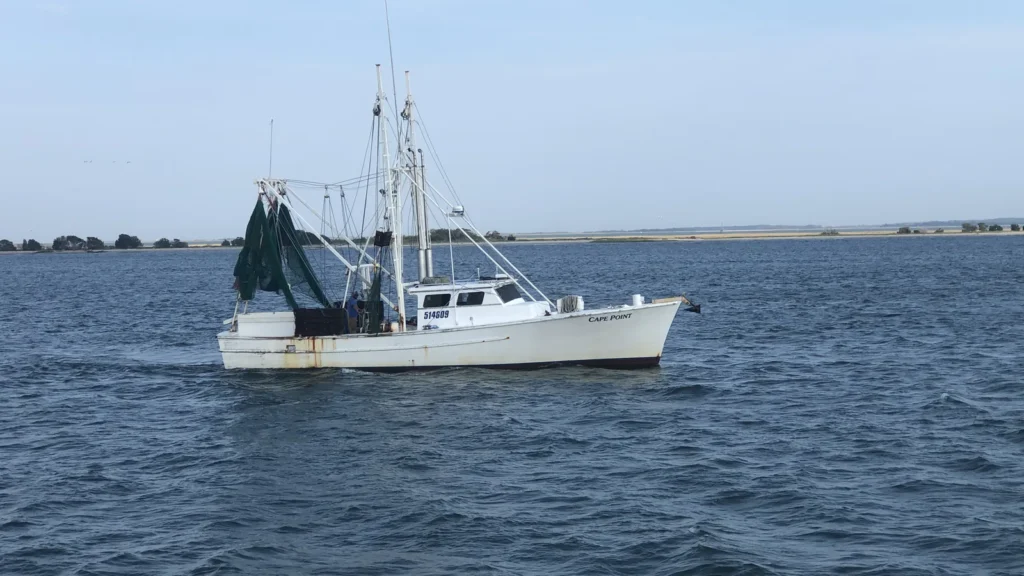
Shrimp trawling is one of the two harvest methods the lawsuit named. Photo: Eric Lander
The 190-page ruling lands as flounder season opens, a half dozen local oyster lease applications have been filed, and the state's fisheries commission weighs a new habitat plan.

A Wake County Superior Court judge ruled Monday that North Carolina has broken its constitutional obligation to protect the state’s coastal fisheries. The decision runs 190 pages, follows a six-week trial held in January and February, and closes out a case the Coastal Conservation Association of North Carolina and 86 individual plaintiffs filed against the state in 2020.
The ruling itself changes nothing on the water today. What it does is put the state’s entire approach to managing fish under court supervision, and few stretches of the coast have more riding on the outcome. Thousands of drivers a day pass a sign on US 17 calling Hampstead the Seafood Capital of the Carolinas. Sneads Ferry works a shrimp fleet. Oyster growers are expanding into Stump Sound and Topsail Sound. Every pier, creek mouth and marsh bank between them feeds a recreational fishery that a lot of local businesses quietly depend on.
Dates to Keep
- Sept. 1-14: the entire 2026 recreational flounder season. One fish per person per day, 15-inch minimum, hook and line or gig only.
- Sept. 1-30: state scoping period on the kingfishes plan, better known here as whiting or sea mullet. A public meeting is set for 6-8 p.m. Sept. 17 at the Division of Marine Fisheries office located at 127 Cardinal Drive Extension in Wilmington.
- Within 45 days of the ruling: both sides must file a joint report on how the remedy phase should proceed.
What the Court Found
Judge Bryan Collins concluded that the state failed its duty under the public trust doctrine, under Article I, Section 38 of the state constitution (the right to hunt and fish, added by voters in 2018), and under Article XIV, Section 5 on conservation of natural resources.
The state’s central defense was that the plaintiffs could not carry their burden because the underlying data has gaps in it. Collins rejected that in the sharpest language in the order. “That argument is specious at best,” he wrote. “The data gaps the Court has found in this case are evidence themselves of management failures by the State and not lack of evidence from Plaintiffs.”
CCA NC says the court cited undisputed evidence that not one of North Carolina’s 13 state-managed coastal fish stocks is currently viable. The full order is posted by Carolina Journal, which also covered the 2022 Court of Appeals decision that let the case reach trial by rejecting the state’s sovereign immunity defense.
What the Region Stands to Win or Lose
The clearest local translation is the flounder season. Two weeks, one fish, 15 inches, same window as 2025. That is what a stock under a rebuilding plan looks like from a Surf City dock, and southern flounder is one of the 13 the court was talking about. The state’s own assessment has that stock overfished with overfishing still occurring, and recreational anglers have exceeded the allowable catch every year since Amendment 3 took effect. The judge did not need to reach any of that to rule the way he did, but it is the same picture from a different angle.
The commercial side of the ledger is just as local. The lawsuit named shrimp trawling and unattended gillnetting as the two harvest methods it blamed for waste, and shrimp trawling is not an abstraction in Sneads Ferry. It is the boats at the docks and the families behind them. When the legislature took up a bill to ban inshore trawling in 2025, commercial fishermen filled the halls in Raleigh and House Republicans dropped the proposal. Nothing in Collins’ order bans anything. But a remedy phase is where a court decides what the state must actually do, and trawling restrictions are the thing the plaintiffs have pushed hardest for.
The newest part of the local seafood economy may have the most to gain. Oyster farming has been growing here, and not entirely by choice. Moratoria and pollution closures farther north have funneled growers into the waters behind Topsail Island, and the state received 49 shellfish lease applications by its Aug. 1 deadline, six of them in Onslow and Pender counties. Those farms are a conservation business model. They need clean, well-monitored water to sell a single oyster, which puts them on the same side of this ruling as the anglers, whatever the local friction over where cages go.
That is the part of the story the headlines miss. About 34% of North Carolina’s coastal waters are permanently closed to shellfish harvest because of pollution and a lack of monitoring capacity. Every acre of that is a business that cannot exist. Conservation is not a cost imposed on the local seafood economy here. It is the precondition for having one.
Which brings me back to the sign. J.H. Lea and Sons opened in Hampstead in 1918, ran for the better part of a century, and is the operation that earned the town the title. It sold to Atlantic Seafood in the early 2000s. The fish house itself was torn down in 2024. The Lea name now goes on two K-8 schools scheduled to open in Hampstead in fall 2027, built because Pender County is one of the fastest growing counties in North Carolina and has added better than 40% to its population since 2010.
I am not calling that a tragedy. The schools are needed and the family earned the honor. But “Seafood Capital of the Carolinas” now describes something that mostly already happened, and getting back to a version of it that is true would require exactly what this ruling asks for: rebuilt stocks, cleaner water, and monitoring good enough to reopen closed bottom. That is slower and less lucrative than approving another subdivision, which is the honest reason it usually loses. A court order does not change that math. It does put it on the record.
The region also has a seat at the table. Sammy Corbett of Hampstead, appointed chair in 2024 and described by the governor’s office as a full-time commercial fisherman with more than forty years in the industry, holds one of the three commercial seats on the nine-member Marine Fisheries Commission. The commission is the body the plaintiffs named, alongside the Division of Marine Fisheries, as having failed the duty.
Both Sides of the Trawling Argument
CCA NC and the North Carolina Wildlife Federation argue that trawl nets sweep up large volumes of juvenile finfish as bycatch, so the finfish stocks never get the chance to rebuild no matter what season lengths the state sets.
Commercial fishermen and their trade groups argue the collapse has other authors: stormwater runoff, nutrient loading, wetland loss and development pressure on the nursery habitat itself, none of which a trawl ban addresses. That argument is not hollow. The three Topsail Island towns have spent several years on an islandwide stormwater program, 15 sites in all, precisely because what runs off the streets ends up in the sound.
One caution on the habitat evidence, since I have seen it stretched. The Albemarle-Pamlico National Estuary Partnership study reporting a 16,000-acre seagrass loss between 2006 and 2020 surveyed waters between Manteo and Bogue Inlet. That is north of here. Stump Sound and Topsail Sound were not in it, and I have found no comparable long-run survey of the grass beds off Sneads Ferry, Surf City or Topsail Beach. Which is close to the judge’s actual point. The absence of data is not the same as the absence of a problem.
Both things can be true. The court did not have to pick, and it declined to referee the science of any single gear type. It ruled on whether the state met a legal duty. It did not.
What Happens Next
The parties have 45 days to file a joint report on scheduling the remedy phase. That is the proceeding worth watching, because it is where any actual change to gear rules, seasons or data collection would originate.
Separately, the Marine Fisheries Commission convened Aug. 19 in Raleigh for a two-day meeting on an agenda set long before the ruling. Commissioners were scheduled to vote Thursday, Aug. 20, on whether to send the 2026 Coastal Habitat Protection Plan amendment out for public and advisory committee review. That plan covers submerged aquatic vegetation, wetlands and coastal water quality, the same habitat questions the commercial side raises. That meeting was still underway as this published, and I will update this piece with the outcome.
The most useful thing a local angler or fisherman can do in the next six weeks is comment on the kingfishes plan. Whiting is a surf staple here, the scoping period runs Sept. 1-30, and the Wilmington meeting on Sept. 17 is the closest one to the Topsail area. Comment periods like that are the part of this system that actually takes public input, and they are almost always undersubscribed.
Editorial Note
This piece reports the ruling and the public record around it. I did not seek comment from the parties, from state officials or from local fishermen, and nothing here should be read as anyone’s reaction. Quotes from the order are drawn from the passages published by Carolina Journal, which posted the full 190-page document. I have not read all 190 pages. Two proceedings referenced above are underway and unresolved as of publication: the Marine Fisheries Commission’s August meeting and the remedy phase of the case. I will follow both.
Advertisement
Support local coverage: Topsail Guide is independently operated and supported by readers. If our stories and guides are useful, you can support the site here.
See something wrong? Report a correction or read our editorial standards.