
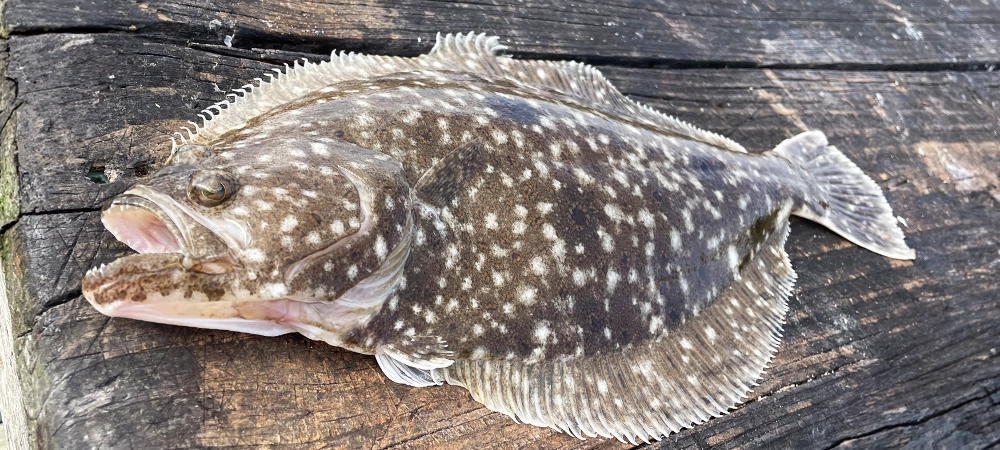
- Season Overview & Opening Dates
- Daily Limits and Enforcement
- How to Measure Your Catch
- How We Got Here: A Brief History of Regulations
- What Anglers Are Saying
- Top Spots and Seasonal Timing Around Topsail
- Gear and Techniques for Hook-and-Line Fishing
- Gigging Gear and Tips
- Recommended Baits and Lures
- Tides, Weather and Finding Flounder
- Community Engagement, Donations and Final Tips
2025 NC Flounder Season & Opening Dates
The 2025 North Carolina recreational flounder season is short but significant. For the first time since 2023, a full two-week season opened on September 1 and continues through September 14, 2025 (source).
The season applies to hook-and-line fishing and gigging, and the same dates are used in coastal, joint and inland waters to avoid confusion (NC DEQ). After the season ends on September 14th there is no open recreational harvest until the following year, so anglers only have fourteen days to legally keep their favorite flatfish.
North Carolina’s coastal counties fought hard to get this season.
In 2024 the Marine Fisheries Commission closed the recreational season altogether, leaving anglers frustrated and forcing many to release hundreds of flounder without ever putting one in the cooler. Public pressure and improvements in the estimated stock allowed regulators to re-open the season in 2025, but with strict quotas and a management plan that aims to rebuild the overfished southern flounder population. Understanding the current limits and the reasons behind them will help anglers stay on the right side of the law and support conservation.
Daily Limits and Enforcement
For 2025 the daily creel limit in North Carolina is one southern flounder per person per day. There is no wiggle room—whether fishing from a boat, pier, shore or wading with a gig, each individual may possess only one flounder. The fish must measure at least 15 inches in total length to be legal (DEQ proclamation).
The limit applies to all recreational gear types, including hook-and-line, gigs, nets and seines, and it remains illegal to harvest flounder with a Recreational Commercial Gear License (NC DEQ).
You may not accumulate multiple daily limits on a boat; if four people are aboard, the vessel may not have more than four flounder at any time. These rules mirror the Marine Fisheries Commission’s Amendment 3 and proposed Amendment 4 to the Southern Flounder Fishery Management Plan, which allocate the total allowable catch between the commercial and recreational sectors.
What happens if you violate the proclamation? North Carolina wildlife laws state that most marine fisheries violations are Class 3 misdemeanors for a first offense, punishable by fines up to $200. A second conviction within three years rises to a Class 2 misdemeanor with fines up to $1,000 and possible jail time. Officers may also seize illegal catch and revoke fishing licenses. In addition to criminal penalties, exceeding the quota triggers “payback” reductions in the following year’s recreational allocation, which is why managers enforce the one-fish limit strictly. To avoid an expensive ticket and to help preserve the stock, release additional flounder immediately after catching your keeper.
How to Measure Your Catch
Total length is the only accepted measure for flounder. Lay the fish flat on a rigid measuring board such as a Golden Rule or Hawg Trough; slide the snout firmly against the 90-degree stop at zero, then pinch the tail lobes together and read the measurement to the tip of the compressed tail.
Do not follow the curvature of the body or use a soft tape measure, and do not measure across the diagonal of a cooler lid. The North Carolina Division of Marine Fisheries defines total length as “the straight-line distance from the tip of the snout to the tip of the compressed tail,” and this is the method officers will use. Fish may shrink slightly after being on ice, so if your flounder barely meets 15 inches when fresh, it could measure short at the dock. Many anglers release fish that are only 15 to 15.25 inches to avoid risking a citation.
How We Got Here: A Brief History of Regulations
Southern flounder populations in North Carolina have been declining for decades.
In 2022 recreational anglers exceeded their annual quota by roughly 56,000 pounds. Because fishery managers require pound-for-pound payback the following year, the 2023 total allowable catch was reduced to 114,315 pounds and managers imposed a two-week season with a one-fish limit.
Dead discards from catch-and-release fishing contribute significantly to mortality; high-grading (replacing a smaller legal fish with a larger one) is also prohibited because it increases kills.
For 2024, the Marine Fisheries Commission decided not to open a recreational season at all, citing overages and the need to help the stock rebuild. The North Carolina Wildlife Resources Commission originally planned to mirror the closure but, after hearing from anglers and local businesses, opened a very limited four-day season in September 2024 (See: WRC for more details).
That closure generated intense debate about allocation fairness. Amendment 3 set the commercial to recreational split at 70/30 for 2023-24, shifting to 60/40 in 2025 and 50/50 in 2026; recreational advocates argued that because anglers fund conservation through license sales and tourism, they deserve a bigger share. The Congressional Sportsmen’s Foundation and other groups urged managers to accelerate the shift to an even split and to implement mandatory harvest reporting to produce more accurate data (CSF). Amendment 4, expected to be decided later in 2025, would officially reallocate the quota 50/50 for 2025 and beyond (see: DEQ update.)
What Anglers Are Saying
The limited 2025 season has sparked strong opinions across the Topsail area. At Surf City Ocean Pier, management posted the announcement on social media, and dozens of anglers responded. Commenters complained that one fish is not enough to feed a family and called the rules a slap in the face; some even joked about under-reporting catch to manipulate quota statistics.
On The Hull Truth boating forum, posters criticized the two-week season and argued that the recreational sector should receive the entire flounder quota rather than just a small portion. Another user warned that the short season will crowd everyone together like the opening day of trout season.
Local charter captains share that frustration but also urge compliance. Captain Allen Jernigan of Breadman Ventures wrote in Coastal Angler magazine that the Division of Marine Fisheries has “decided to give recreational anglers in NC a 2-week flounder season this year. How generous.” He sarcastically notes that “we are the problem with a hook and a pointed stick” while commercial effort remains significant. Jernigan advises clients to target flounder with Carolina rigs and live baits, to fan cast around structure like bridges, docks and rock piles, and to move frequently until finding a bite.
In early September local news filmed cousins Tony Talman and Wells Gray as they fished on the Cape Fear River and Intracoastal Waterway. They released several sub-legal fish before finally boating a 16-inch keeper. Talman, who runs Reel Teal Charters, reported releasing around 185 flounder before the season opened and emphasized that everyone wants to fish as often as possible during the short window. The general mood is a mix of excitement at being allowed to harvest any flounder at all and frustration at the restrictions.
Top Spots and Seasonal Timing Around Topsail
Flounder move between inshore estuaries and near-shore ocean reefs throughout the year. Locally around Topsail Island, sound-side creeks, marsh banks, and oyster rocks hold numbers of keeper flounder from May through early November. Peaks often occur in June and again in September when the fish feed aggressively before migrating offshore to spawn.
The calm waters behind Topsail and Surf City offer excellent action, especially along creek mouths, dock pilings, and shallow ledges where flounder wait to ambush baitfish. On the ocean side, near-shore reefs, ledges, and live-bottom areas a few miles off the beach produce larger “doormat” flounder; local guides run charters to these spots when weather allows. Community events, tournaments, and seafood festivals often coincide with flounder season, creating a festive atmosphere along the island.
Other regional hotspots accessible from Topsail include the New River and Cape Fear River, the waters around Wilmington, and the numerous creek mouths feeding the Intracoastal Waterway. While Outer Banks and Pamlico Sound are well-known flounder destinations, they are too far north to be practical for most Topsail anglers. Instead, focus on local waters and talk to bait shops for up-to-date reports.
Gear and Techniques for Hook-and-Line Fishing
A balanced inshore spinning setup works well for flounder. Choose a medium-action rod around 7 feet paired with a reel spooled with 10- to 15-pound braid and a 15-pound fluorocarbon leader. The classic Carolina rig remains the go-to method: slide a 1/2- to 1-ounce egg sinker on your main line above a swivel, then tie on 18–24 inches of leader and a size 2/0 to 3/0 circle or kahle hook. Use live baits such as finger mullet, mud minnows, menhaden or live shrimp. Cast the rig near structure and work it slowly along the bottom; flounder often hit softly, so wait for the “thump” and apply steady pressure rather than jerking.
Soft plastics also produce: paddle tails, curly tails and Gulp! shrimp in colors like chartreuse, white, pink or natural brown mimic baitfish and will draw strikes when hopped along the bottom. Bounce your lure over sand pockets near grass edges, bridge pilings and oyster bars. Fan cast to cover an area; flounder often school together, so catching one means there are more nearby.
On the pier, use a Carolina rig with a heavier sinker to keep your bait near the pilings or drop straight down in the “suds” where waves meet the beach. Surf City Ocean Pier recommends live mullet strips, mud minnows or live shrimp fished on a Carolina rig near the pilings. Keep your rod tip low and be patient; flounder may mouth the bait for several seconds before committing. Once you catch your one legal fish for the day, switch to targeting other species or simply enjoy catch-and-release.
Gigging Gear and Tips
Flounder gigging—spearing fish in shallow water at night—has long roots in coastal Carolina culture. Today, gigging is subject to the same one-fish limit and 15-inch minimum as hook-and-line fishing (DEQ rules).
To gig successfully, equip yourself with:
• Gig: Choose a pole between 6 and 12 feet long made of lightweight aluminum, fiberglass or wood. A three-pronged stainless-steel head with barbed tines holds the fish securely; longer poles help reach deeper water but are harder to control in currents (Read: Gear Basics).
• Lighting: Visibility is everything. Use a waterproof LED headlamp for hands-free scanning, or mount powerful underwater LED lights on your boat or long pole. Look for lights that produce at least 1,000 lumens and have a run time of 6–8 hours with a high water-resistance rating (IPX7 or higher). We recommend reading up on lighting tips – noting that some giggers prefer carrying a handheld spotlight to illuminate the bottom and quickly shine fish.
• Vessel and mobility: Many giggers wade through ankle- to knee-deep flats, wearing old sneakers or wading boots. A shallow-draft skiff or jon boat with a poling platform and a push pole allows you to cover more ground quietly. Install an anchor system or GPS-anchoring trolling motor so you can stop and stalk fish without drifting.
The best conditions for gigging are during a falling tide at night when the water is clear and calm when to go. Low tide concentrates flounder in shallow areas near sand flats, creek mouths and marsh edges. Move slowly, scanning the bottom for the faint outline of a flounder; the fish will be partially buried with only eyes and part of the head visible. When you spot one, position the gig directly above and thrust firmly. Practice judging size; it is better to pass on a borderline fish than risk an undersized violation. Guides like Captain Jernigan run nighttime gigging trips and can teach beginners how to handle the equipment and read the water guided trips.
Recommended Baits & Lures
Live bait is king for flounder. Finger mullet (3–5 inch fish), mud minnows, small menhaden, and live shrimp stay lively on a hook and emit vibrations flounder detect from their sandy hiding spots. Hook the bait through the lips or just in front of the dorsal fin so it swims naturally. Strip baits cut from mullet, menhaden, or squid also work well when drifted along the bottom; use a single strip on a kahle hook and add scent like Pro-Cure to entice lethargic fish.
Artificial lures shine when covering water quickly. Soft-plastic paddletails, curly tails, and jerk shads rigged on jig heads allow you to hop or drag them along the bottom. Colors such as chartreuse, white, pink, and new penny mimic local baitfish. Berkley Gulp! Swimming Mullet and Gulp! Shrimp are favorites because they combine movement with a strong scent. Bucktail jigs tipped with strip baits or Gulp! also work, especially in deeper channels or when vertical jigging around reef structure. Remember to fish slowly; flounder rely on ambush and will often follow the lure before biting.
Tides, Weather and Finding Flounder
Understanding tides can dramatically increase your success. The outgoing portion of a high tide is widely considered the best time for inshore flounder fishing because it flushes shrimp, crabs, and baitfish off grass flats and oyster bars, forcing them past flounder hidden at ambush points. Cast upcurrent and allow your bait to drift naturally down the current, keeping contact with the bottom. Creek mouths, inlets, and channels are prime because flounder position themselves to intercept prey. Around docks, work jigs slowly along the pilings; flounder often suspend near shadows created by the structure.
On grass flats at low tide, target sandy potholes and depressions where fish gather; cover each pothole thoroughly before moving to the next spot. While low tide can still produce fish, the outgoing high tide typically yields the most active feeding and the best chance to fool a doormat.
Weather also matters. Flounder bite best when water clarity is good and there is some current to move bait. Too much freshwater from heavy rains will push flounder toward inlets or out into the ocean where salinity remains stable. Light winds and cloudy skies are ideal; bright midday sun can make fish wary, but on overcast days they may feed all day.
Community Engagement, Donations & Final Tips
The 2025 season may be brief, but it has already generated a surge of interest along Topsail Island. Local bait shops, charter boats, and restaurants welcome the influx of visitors and encourage anglers to respect the resource and follow the regulations. Because the season is so short, plan your trips carefully. Fish early mornings and late afternoons when boat traffic is low and flounder feed more actively. If you keep a fish, consider donating the carcass to the North Carolina Division of Marine Fisheries’ carcass collection program.
Researchers use otoliths (ear bones) from carcasses to determine the age and growth rate of flounder, information that helps refine future management. Drop-off locations include Pelagic Hunter in Sneads Ferry, Intracoastal Angler in Wilmington, and several other sites statewide; leave the head and tail intact when donating.
Anglers sometimes wonder whether newly proposed legislation, such as House Bill 442, will expand the season or restrict trawling. The debate continues: commercial shrimpers argue that trawling restrictions would put them out of business, while conservation groups say large-scale trawling kills millions of juvenile fish and destroys habitat. For now, the best way to influence future seasons is to follow the rules and participate in public comment periods when the Marine Fisheries Commission considers changes. Document your catch honestly and engage with local advocacy groups. Together, recreational anglers can ensure that future generations will enjoy catching flounder off Topsail.
The 2025 flounder season is a precious opportunity. By understanding the rules, refining your techniques, and appreciating the history behind the regulations, you can make the most of your limited days on the water. Whether you are casting from Surf City Pier, drifting over a near-shore reef, or stalking shallow flats with a gig, practice patience, ethics, and respect for the fishery. Enjoy your time on the water, and remember that protecting the resource today ensures more abundant flounder tomorrow.
